Internet Speed for Lion OTT IPTV on Firestick
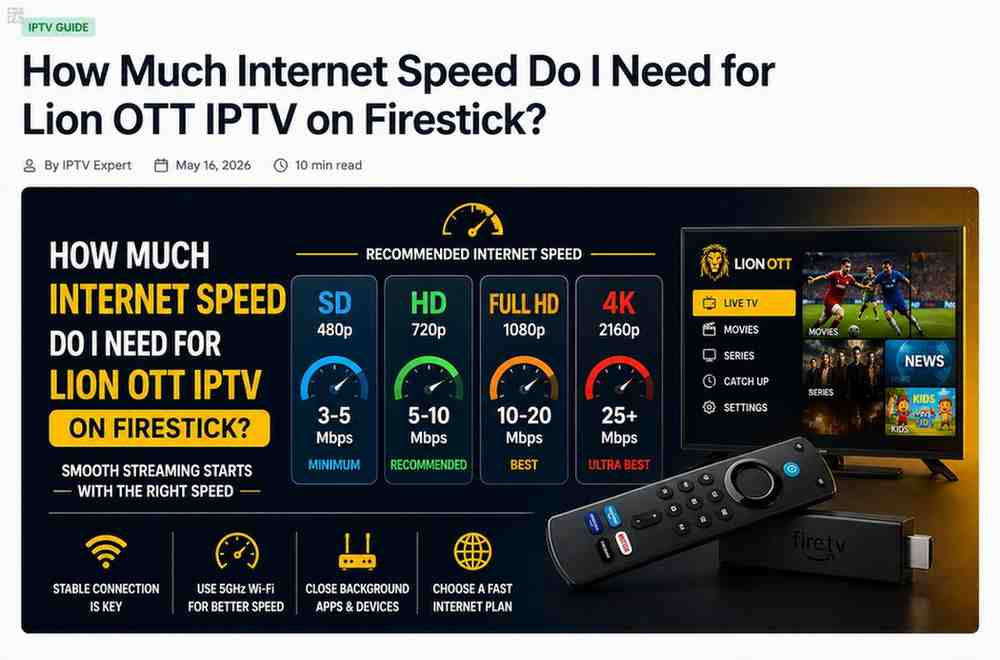
To stream Lion OTT IPTV on a Firestick smoothly, you’ll need a minimum Lion OTT IPTV speed of 3–5 Mbps for standard definition, 5–15 Mbps for HD, and at least 15–25 Mbps for a reliable 4K Lion OTT IPTV speed experience.
These numbers sound small, but they are just the starting point for Lion OTT IPTV speed. Several key factors at home and beyond can dramatically influence the Lion OTT IPTV speed you actually need.
Internet Speed Requirements at a Glance
Whether you’re unwinding with a movie or catching the game live, the video quality you want largely dictates your internet needs. Your Fire TV Stick is a small but powerful device, and like all streaming devices, it has a healthy appetite for bandwidth. For most streaming on an Amazon Fire TV Stick, a baseline speed of 3 Mbps is the absolute minimum for Standard Definition (SD) to function.
However, for a truly pleasant Lion OTT IPTV experience, you’ll want to aim much higher. Here’s how your chosen picture quality directly translates to internet requirements:
- Standard Definition (SD): Good for small screens or if you have a very limited connection.
- Minimum Stable Speed: 3-5 Mbps
- Lion OTT IPTV & Firestick Reality: This will work, but you’re right on the edge. Any network hiccup will probably cause buffering.
- High Definition (HD – 720p & 1080p): The sweet spot for most viewers. Offers a great balance of quality and bandwidth.
- Minimum Stable Speed: 5-10 Mbps
- Recommended Speed for a Buffer-Free Experience: 10-15 Mbps
- 4K Ultra HD (UHD): The pinnacle of picture quality, offering stunning detail.
- Minimum Stable Speed: 15-25 Mbps
- Recommended Speed for a Buffer-Free Experience: 25-50 Mbps (This higher buffer accounts for live events, network fluctuations, and other devices in your home.)
The Bitrate Reality Check
A major factor often overlooked is the bitrate of the video stream. Bitrate refers to the amount of data processed per second of video playback. A modern streaming platform with high-efficiency codecs like H.265 can provide a beautiful 4K picture at a bitrate of 15-25 Mbps. This is much more efficient. On the other hand, numerous user reviews for IPTV services mention that their “HD” or “4K” channels can often be poor quality.
An IPTV provider might label a channel as “HD,” but it could be using an older, less efficient codec or a lower bitrate, meaning it might actually require more bandwidth to look decent compared to a service like Netflix or Amazon Prime.
The Invisible Factors: Why You Might Need More Speed
If you’re not in control of these variables, your viewing experience can turn sour quickly. Understanding these hidden forces that eat away at your bandwidth is half the battle:
1. The Throttling Trap
Many Internet Service Providers (ISPs) practice deliberate slowdowns, known as throttling. This is a forced speed reduction by your ISP, often when they see heavy data usage during peak hours (like evenings and weekends).
When your ISP detects a stream from a less mainstream IPTV service, it’s a prime target. By encrypting your traffic, a VPN makes your stream invisible to your ISP, potentially allowing you to bypass throttling altogether.
2. The Firestick’s Wi-Fi Prowess
The Fire TV Stick, by default, connects via Wi-Fi. While convenient, wireless connections are far from perfect. Physical obstacles and interference from other electronics can significantly impact signal strength. For the ultimate stability, consider the upgrade to a wired connection. An Amazon Ethernet Adapter for your Firestick is a game-changer, providing a rock-solid, interference-free pipeline for your data.
3. The Congested Home Network
Your internet plan’s bandwidth is a shared pipe for your entire household. The internet speed you pay for is divided amongst all active users and devices. Light browsing might only consume 1-2 Mbps, but heavy use adds up fast. If your family is simultaneously gaming, or even just scrolling through Instagram Reels, the available bandwidth for your Lion OTT IPTV stream shrinks.
4. Geographical Distance and Infrastructure
The physical distance between your local device and the IPTV’s server is also a critical factor. If the Lion OTT IPTV service hosts its primary servers far from your region, your data has to travel a long distance, increasing latency (lag) and making the stream more susceptible to interruptions. A reputable IPTV provider like Lion IPTV uses “load balancing and smart routing,” which is a fancy way of saying they have systems in place to help manage this, but the fundamental laws of physics still apply.
5. The Great Wi-Fi Frequency Debate
Your router likely broadcasts on two main frequencies: 2.4 GHz and 5 GHz.
- 2.4 GHz: This signal travels further and is better at penetrating walls, but it is slower and more prone to interference from other common household devices like microwaves and baby monitors.
- 5 GHz: This frequency offers faster speeds and is less prone to interference, making it ideal for high-bitrate streaming. However, its range is shorter, and it struggles more with physical obstacles.
Ideally, you want your Firestick connected to your 5 GHz Wi-Fi network for the best streaming performance.
Testing and Troubleshooting Your Firestick’s Speed
Before you spend money on a faster connection, use these simple methods to see your actual streaming performance.
How to Run a Speed Test on Your Firestick
- The Built-In Method: Go to Settings > Network and highlight your Wi-Fi network. Then, press the Play/Pause button on your remote. Your Firestick will test your network’s signal strength and connection speed.
- With an App: You can also download a speed test app from the Amazon Appstore by typing “speed test” into the search field.
- Run Multiple Tests: Network speeds can fluctuate. Run your test several times at different times of the day to get a realistic picture of your average and peak performance.
Step-by-Step Troubleshooting Guide
| Problem | Diagnostic Step | Solution |
| Slow Speed | Run a speed test. Compare the result to your ISP plan’s promised speed. | Contact your ISP. Test at different times of the day. Upgrade your plan. |
| ISP Throttling | Compare your speed with and without a VPN. | Use a reliable VPN for IPTV to encrypt your traffic and bypass ISP throttling. |
| Weak Wi-Fi Signal | Check the signal bars on your Firestick (Settings > Network). | Move your router closer. Reduce interference. Switch to an Ethernet adapter for a wired connection. |
| Background Apps/Downloads | Check for downloads and close background apps. | Pause large downloads. Close unused apps (double-tap home button and swipe up). |
| Outdated Hardware/App | Check your Firestick and app for updates. | Check for updates manually (Settings > My Fire TV > About > Check for Updates). Update your IPTV app. |
The Invisible Factors: Why You Might Need More Speed (Part 2)
The Fresh Start Effect: Restarting and Clearing Cache
Simply turning your Firestick off and on again with a restart is a highly effective solution. This action shuts down all background services that might be quietly consuming resources. Over time, cached data from apps can build up and cause performance issues. Clearing the app cache for your IPTV player via Settings > Applications > Manage Installed Applications is a great digital spring cleaning task.
The Ethernet vs. Wi-Fi Debate
While Wi-Fi offers convenience, a wired Ethernet connection remains the gold standard for consistent, high-speed streaming. By using an approved Ethernet adapter, you bypass wireless interference and signal instability entirely, providing the most reliable pipeline for demanding 4K streams.
The Golden Ticket Strategy
Ultimately, the internet speed you need for Lion OTT IPTV on Firestick is not just about a single number. It’s about the combined effect of several factors. Here are your key takeaways:
- Don’t Skimp on the Cushion: For a stress-free experience, especially with 4K, aim for 25-50 Mbps. This extra capacity handles occasional network dips.
- Harness the 5 GHz Lane: Make sure your Firestick is on your router’s 5 GHz Wi-Fi band. This is crucial for pushing through high-quality video.
- Fight Throttling with a VPN: If you suspect throttling, a fast VPN is a powerful tool to bypass it.
- Consider Wired for Peak Performance: For the ultimate low-latency, buffer-free 4K streaming, a wired Ethernet connection for your Firestick is the best investment you can make.
- Simple Fixes First: A restart, an app cache clear, or moving your router can instantly solve many speed-related issues.
- Choose Quality: The quality of your IPTV provider matters. An efficient service with good servers will perform better on the same connection speed than a poorly optimized one.
Final Verdict
So, what’s the bottom line? For most homes, an internet plan offering 25-50 Mbps will provide enough bandwidth to comfortably run Lion OTT IPTV on a Firestick at 4K resolution, even with a couple of other devices running in the background.
Think of your internet speed requirement not as a single answer, but as a range. Your actual needed speed can comfortably sit at the lower end or be forced to the higher end based on your home network, your ISP’s practices, and the quality of your IPTV provider. By using the troubleshooting table and adopting the golden ticket strategies, you’ll have the tools to not just watch, but master your stream.