Lion OTT IPTV ISP Detection: Can Your ISP See Your Streaming Activity?
If you’re using IPTV, especially a service like Lion OTT IPTV, one question naturally comes up: can my internet provider actually see what I’m doing, and how does Lion OTT IPTV ISP detection really work?
It’s a fair concern. You’re streaming content, using data, and connecting to servers—so it makes sense to wonder how much of that is visible behind the scenes, especially regarding Lion OTT IPTV ISP detection.
The short answer is: your ISP can see some things, but not everything.
In this guide, we’ll break down Lion OTT IPTV ISP detection in a simple, realistic, and human way—no technical overload, no confusion—just clear answers you can actually use.
Understanding What an ISP Does
Before diving into detection, it helps to understand what your ISP actually is.
Your Internet Service Provider is the company that gives you access to the internet. Every website you visit, every app you use, and every stream you watch passes through their network.
That means they have a certain level of visibility into your activity.
But that visibility has limits.
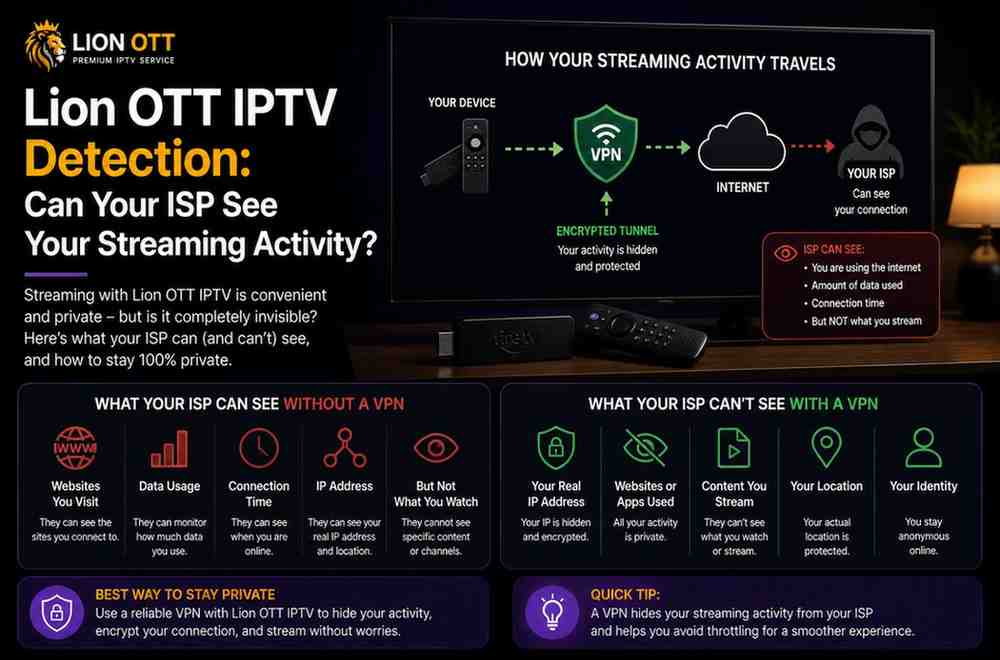
What Your ISP Can See When You Use Lion OTT IPTV
When you stream using Lion OTT IPTV, your ISP can typically detect:
1. Data Usage
They can see how much data you’re consuming. Streaming video uses a lot of bandwidth, so this is easy to identify.
2. Connection Activity
They know when you’re online, how long you’re connected, and how active your connection is.
3. Server Connections
Your ISP can see the IP addresses or domains your device connects to.
This means they might notice that you’re connecting to streaming servers.
4. Type of Traffic
Even without exact details, ISPs can often recognize patterns that suggest video streaming.
So yes—Lion OTT IPTV usage can appear as streaming activity.
What Your ISP Cannot Clearly See
Now here’s the part that most people misunderstand.
Even though your ISP sees activity, they usually cannot see the exact content.
They typically cannot see:
- The specific channels you’re watching
- The movies or shows you select
- Your app interface or navigation
- Your login details
So while they know you’re streaming, they usually don’t know what exactly you’re watching on Lion OTT IPTV.
Can Your ISP Tell It’s IPTV?
This depends on a few factors.
Sometimes, yes—your ISP may be able to guess or identify IPTV usage.
This happens when:
- The service uses known or recognizable servers
- Traffic patterns match IPTV behavior
- The connection isn’t strongly encrypted
In these cases, Lion OTT IPTV might be identifiable as IPTV traffic.
But it’s not always guaranteed.
What Is ISP Throttling?
One of the biggest concerns related to IPTV is throttling.
What does that mean?
Throttling is when your ISP intentionally slows down certain types of internet traffic.
This can happen during:
- Peak hours
- High network congestion
- Heavy streaming usage
If your ISP detects streaming activity (including Lion OTT IPTV), they may reduce speed—leading to buffering.
Signs You Might Be Experiencing Throttling
Here are some common signs:
- Streaming buffers even with good internet speed
- Quality drops during peak hours
- IPTV works better at night than evening
- Speed tests look fine, but streaming doesn’t
These are not guaranteed—but they can be indicators.
Does a VPN Hide IPTV Activity?
Yes—a VPN changes what your ISP can see.
When you use a VPN:
- Your traffic is encrypted
- Your real IP address is hidden
- Your ISP can’t see which servers you connect to
So instead of seeing Lion OTT IPTV, your ISP only sees encrypted data.
What Your ISP Sees With a VPN
With a VPN active, your ISP can still see:
- That you’re using data
- That you’re connected to a VPN server
But they cannot see:
- Which apps you’re using
- What content you’re streaming
- Whether you’re using IPTV
This adds a layer of privacy.
Do You Need a VPN for Lion OTT IPTV?
Not always.
Many users run Lion OTT IPTV without a VPN and have no issues at all.
A VPN becomes useful if:
- You want more privacy
- You suspect throttling
- You experience buffering without reason
Otherwise, it’s optional.
Pros of Using a VPN
- Better privacy
- Encrypted connection
- Potentially smoother streaming (in some cases)
- Protection from ISP monitoring
Cons of Using a VPN
- Slight speed reduction
- Extra setup required
- Monthly subscription cost
- Not always necessary
So it’s not something you should use blindly.
How to Test If Your ISP Is Affecting IPTV
Here’s a simple way to check:
- Stream Lion OTT IPTV without VPN
- Note performance (buffering, speed, quality)
- Turn on VPN and test again
- If performance improves → ISP may be affecting traffic
- If nothing changes → VPN may not be needed
This is the most practical approach.
Real-Life Perspective
In real-world use, most people fall into two groups:
Group 1: No VPN Users
- Stable connection
- Smooth streaming
- No issues
Group 2: VPN Users
- Faced buffering or restrictions
- Saw improvement with VPN
Both are valid.
Common Myths About ISP Detection
Let’s clear up a few misconceptions.
“My ISP can see everything I watch”
Not true. They see activity—not exact content.
“IPTV is always detected”
Not always. It depends on encryption and servers.
“VPN is mandatory”
No—it’s optional based on your needs.
Final Thoughts
So, can your ISP detect Lion OTT IPTV streaming?
Yes—but only partially.
They can see:
- That you’re streaming
- How much data you use
- Which servers you connect to
But they usually cannot see:
- What you’re watching
- Specific channels or content
If privacy or throttling concerns you, a VPN can help—but it’s not required for everyone.
The best approach is simple: test your setup, understand your experience, and choose what actually works for you.
Because at the end of the day, streaming should be smooth, simple, and stress-free.